Fractional CTO Services: What They Cost and What You Get
Not every company needs a full-time Chief Technology Officer. For many startups, scale-ups, and mid-market businesses, the technology leadership gap is real -- but the budget, stage, or workload does not justify a permanent C-suite hire at $250K-400K per year.
This is where fractional CTO services come in. A fractional CTO provides senior technology leadership on a part-time or project basis, giving your company access to CTO-level expertise without the cost and commitment of a full-time executive.
But what do fractional CTO services actually include? How much do they cost? And how do you evaluate whether this model is right for your company?
This guide breaks down the typical service offerings, engagement models, cost ranges, and deliverables -- so you can make an informed decision.
What Fractional CTO Services Typically Include
The scope of fractional CTO services varies depending on the provider and engagement model, but most fractional CTOs offer some combination of the following:
Technology Strategy and Roadmap
A fractional CTO helps you define where your technology needs to go and how to get there. This includes evaluating your current stack, identifying gaps and risks, and creating a prioritised technology roadmap that aligns with your business goals.
For companies without technical leadership, this is often the most immediately valuable service. It replaces guesswork with a clear plan.
Architecture Review and Technical Due Diligence
Whether you are building a new product, preparing for a funding round, or evaluating an acquisition target, architecture review is a core fractional CTO service. This involves assessing system design, code quality, scalability bottlenecks, security posture, and technical debt.
Investors and acquirers frequently engage fractional CTOs specifically for technical due diligence -- an independent assessment of a company's technology assets and risks.
Hiring and Team Building
Many fractional CTOs help companies build their engineering teams from scratch or restructure existing ones. This includes defining roles, writing job descriptions, screening candidates, conducting technical interviews, and establishing onboarding processes.
For early-stage companies, a fractional CTO might hire the first three to five engineers and set the engineering culture before handing off to a full-time VP of Engineering or technical co-founder.
Vendor and Tool Evaluation
Build vs. buy decisions can make or break an early-stage company's runway. A fractional CTO brings experience across dozens of technology stacks and vendor ecosystems, helping you evaluate options objectively rather than defaulting to whatever the most senior developer happens to know.
This covers everything from cloud infrastructure providers to SaaS tools, development platforms, and third-party APIs.
Process and Engineering Operations
Fractional CTOs frequently implement or improve engineering processes: CI/CD pipelines, code review workflows, sprint planning, incident response procedures, and deployment strategies. These operational foundations are often neglected by development teams that lack experienced technical leadership.
The goal is not to impose heavyweight process for its own sake, but to establish the minimum viable structure that allows teams to ship reliably and respond to problems quickly.
Security, Compliance, and Risk Management
For companies handling sensitive data or operating in regulated industries, a fractional CTO can assess your security posture, identify compliance gaps (SOC 2, GDPR, HIPAA), and create a remediation plan. Some fractional CTOs also help manage the compliance certification process itself.
Common Service Tiers
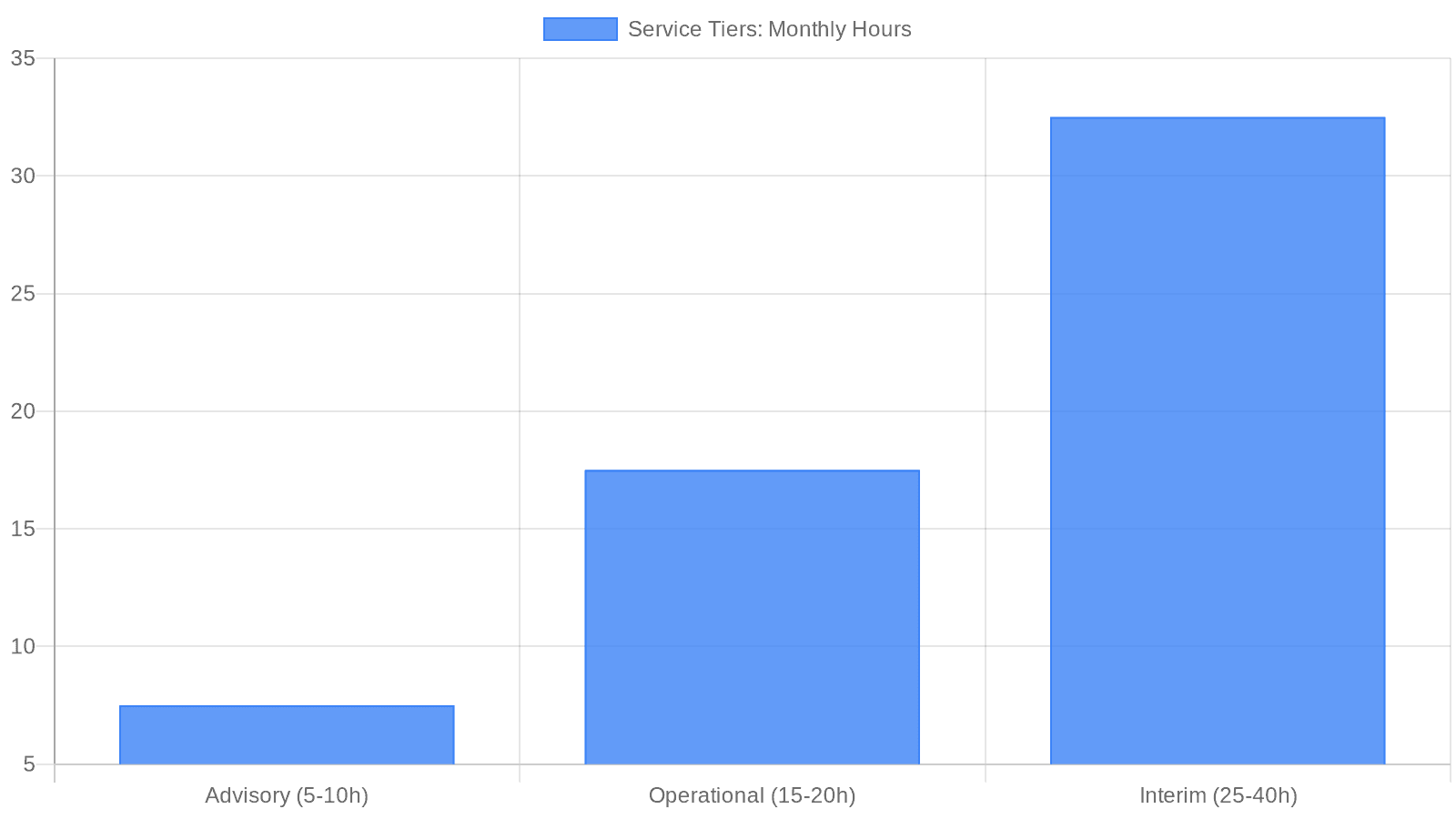
Fractional CTO engagements typically fall into three broad tiers, defined by time commitment and scope.
Advisory / Light-Touch (5-10 Hours per Month)
This tier is best suited for companies that have a functioning development team but need strategic guidance. The fractional CTO acts as a sounding board and advisor rather than an operational leader.
What you get:
- Monthly or bi-weekly strategy sessions
- Technology roadmap input and review
- Architecture guidance on major decisions
- Ad hoc availability for urgent technical questions
- Board or investor meeting preparation
Best for: Early-stage startups with a technical co-founder who needs a more experienced mentor, or established businesses with a capable development team that lacks C-level strategic oversight.
Operational (15-20 Hours per Month)
At this level, the fractional CTO is actively involved in execution -- not just strategy. They attend team standups, participate in hiring, review pull requests on critical systems, and drive technical initiatives forward.
What you get:
- Everything in the advisory tier
- Active participation in engineering team meetings
- Hands-on hiring support (sourcing, screening, interviews)
- Vendor negotiations and procurement decisions
- Sprint planning input and delivery oversight
- Regular reporting to the CEO or board
Best for: Companies in active growth mode that need a technology leader to guide execution, but do not yet have the budget or workload for a full-time CTO.
Interim / Embedded (25-40 Hours per Month)
This is the most intensive engagement -- functionally equivalent to a part-time or near-full-time CTO. The fractional CTO is embedded in the organisation, leading the engineering function day-to-day.
What you get:
- Full CTO responsibilities on a part-time basis
- Direct management of engineering leads or the entire team
- Ownership of technical strategy, execution, and outcomes
- Stakeholder management (investors, partners, customers)
- Transition planning toward a full-time CTO hire
Best for: Companies that need immediate CTO-level leadership -- often during a transition period (CTO departure, rapid scaling, pre-acquisition) -- but cannot or do not want to rush a permanent hire.
Cost Ranges for Fractional CTO Services

Pricing varies based on geography, the fractional CTO's experience level, industry specialisation, and engagement scope. The following ranges reflect what is commonly seen across the market:
Hourly Rates
Fractional CTOs typically charge between $150 and $350 per hour, depending on experience and specialisation. CTOs with deep expertise in specific domains (fintech, healthcare, AI/ML) or those with strong track records at well-known companies tend to command rates at the higher end.
Monthly Retainers
Most fractional CTO engagements use a monthly retainer model rather than hourly billing. Typical ranges:
- Advisory tier: $3,000 to $5,000 per month
- Operational tier: $5,000 to $10,000 per month
- Interim/embedded tier: $10,000 to $15,000 per month (or higher for very senior profiles)
Retainers provide predictability for both sides and typically offer better value than hourly billing for ongoing engagements. For a deeper analysis of compensation benchmarks, see our fractional CTO salary guide.
Project-Based Pricing
Some fractional CTOs offer fixed-price engagements for defined deliverables:
- Technology audit: $5,000 to $15,000
- Technical due diligence: $5,000 to $20,000
- Architecture review and roadmap: $8,000 to $25,000
- Hiring sprint (build a team of 3-5 engineers): $10,000 to $30,000
Project-based pricing works well when the scope is clear and bounded. For ongoing advisory relationships, retainers are more common.
How This Compares to Full-Time
A full-time CTO at a funded startup typically costs $200,000 to $350,000 in base salary, plus equity, benefits, and recruiting costs. Total compensation can easily exceed $400,000 per year.
A fractional CTO at the operational tier -- providing meaningful, hands-on leadership -- typically costs $60,000 to $120,000 per year. That is roughly 25-35% of the fully-loaded cost of a full-time CTO, while covering the strategic and leadership functions that matter most.
What Deliverables to Expect
A good fractional CTO does not just show up for calls and offer opinions. You should expect tangible deliverables, including:
- Technology roadmap document -- a prioritised plan covering the next 6-12 months, updated quarterly
- Architecture documentation -- system design diagrams, data flow maps, and decision records for key technical choices
- Hiring plans and processes -- role definitions, interview frameworks, and candidate scorecards
- Risk assessments -- security audit findings, compliance gap analysis, and remediation timelines
- Engineering metrics dashboard -- deployment frequency, lead time, incident rates, and team velocity trends
- Board-ready technology updates -- slides or memos summarising technical progress, risks, and investment needs
- Vendor evaluation reports -- structured comparisons for major build-vs-buy and platform decisions
The specific deliverables should be agreed upon at the start of the engagement and reviewed regularly.
How to Evaluate a Fractional CTO

Not all fractional CTOs are created equal. Here is what to look for -- and what to watch out for.
Green Flags
- Breadth of experience across company stages. The best fractional CTOs have worked with early-stage startups, growth-stage companies, and enterprises. They can calibrate their advice to your specific context rather than applying a one-size-fits-all playbook.
- Clear communication with non-technical stakeholders. A fractional CTO who cannot explain technical trade-offs to a CEO or board in plain language is not doing the job. Communication is arguably the most critical CTO skill.
- Defined deliverables and accountability. Look for someone who proposes specific outcomes, timelines, and check-in cadences -- not vague promises to "provide guidance."
- References from companies at your stage. Ask to speak with previous clients, ideally ones that were at a similar stage and faced similar challenges.
- Willingness to say "I don't know." The technology landscape is vast. A fractional CTO who claims expertise in everything is either exaggerating or spreading themselves too thin.
Red Flags
- No track record as a CTO or senior engineering leader. A strong individual contributor or architect does not automatically make a good CTO. The role requires business acumen, people leadership, and stakeholder management -- not just technical depth.
- Pushing a specific technology stack before understanding your business. If a fractional CTO arrives with a predetermined architecture before learning about your product, market, and constraints, they are solving the wrong problem.
- Unavailable or unresponsive. Fractional CTOs serve multiple clients. If they are consistently slow to respond or miss meetings, they are overcommitted.
- No interest in your business model or customers. Technology strategy that is disconnected from business reality is just expensive architecture tourism.
- Resistance to documenting decisions. If your fractional CTO keeps everything in their head, you have a dependency problem -- not a leadership solution.
When to Transition to a Full-Time CTO
Fractional CTO services are not meant to be a permanent arrangement for every company. Here are signals that it may be time to hire a full-time CTO:
- Your engineering team exceeds 15-20 people and needs dedicated day-to-day leadership that a part-time engagement cannot provide.
- Technology is your core competitive advantage and requires full-time strategic attention at the executive level.
- You are entering a phase of rapid technical complexity -- new product lines, international expansion, or regulatory requirements that demand constant CTO-level decision-making.
- Your fractional CTO's hours keep creeping up toward 30-40 hours per month, and the cost difference versus a full-time hire is narrowing.
- You need a CTO for fundraising or M&A where investors or acquirers expect a permanent technology executive on the leadership team.
A good fractional CTO will proactively raise this conversation. In fact, one of the most valuable things a fractional CTO can do is help you define the full-time CTO role, run the search, and manage the transition -- ensuring continuity rather than disruption.
Where to Find Fractional CTO Services
There are several channels for finding a qualified fractional CTO:
Fractional Executive Networks
Dedicated platforms that specialise in fractional C-suite placements are typically the most efficient route. Fractional Chiefs is a marketplace specifically designed to connect companies with vetted fractional executives -- including fractional CTOs, CFOs, CMOs, and other C-suite roles. Networks like these pre-screen candidates, which saves you significant time compared to sourcing independently.
Referrals and Professional Networks
Ask your investors, advisors, and peer CEOs for recommendations. The fractional CTO market is relationship-driven, and the best practitioners often have waitlists based on reputation alone.
CTO Coaching and Advisory Firms
Some technology leadership advisory firms offer fractional CTO services alongside coaching and development programs. The advantage is a structured methodology rather than a purely individual approach. If you are exploring whether you need a fractional CTO or want to develop your existing technical leadership, our CTO readiness assessment can help clarify where the gaps are.
Independent Consultants
Many experienced CTOs offer fractional services independently. LinkedIn, CTO-focused communities, and technology leadership events are good places to find them. The trade-off is that you are responsible for vetting them yourself.
Regardless of the channel, always conduct thorough reference checks and start with a short trial engagement (one to three months) before committing to a longer-term retainer.
Making the Most of a Fractional CTO Engagement
Once you have selected a fractional CTO, set the engagement up for success:
- Define clear objectives. What specific outcomes do you need in the first 90 days? Align on three to five measurable goals.
- Ensure executive access. The fractional CTO needs direct, regular access to the CEO and other key stakeholders. Do not bury them under layers of middle management.
- Share context generously. Provide access to financials, product roadmaps, customer feedback, and strategic plans. A fractional CTO operating with incomplete information will give you incomplete advice.
- Establish a communication rhythm. Weekly check-ins with the CEO, regular touchpoints with the engineering team, and monthly written updates create accountability without micromanagement.
- Set a review cadence. Evaluate the engagement formally at 90-day intervals. Adjust scope, deliverables, and time commitment based on what is working and what is not.
Conclusion
Fractional CTO services offer a practical path to senior technology leadership for companies that are not ready -- or do not need -- a full-time CTO. The model provides strategic guidance, hands-on technical leadership, and organisational expertise at a fraction of the cost.
The key is matching the right engagement model to your company's stage, needs, and budget. Start with a clear understanding of what you need (use our CTO readiness assessment to help define this), evaluate candidates rigorously, and structure the engagement around defined deliverables and accountability.
Whether you are a startup founder trying to understand what a CTO actually does, or a growing company that has outgrown its ad hoc technical leadership, fractional CTO services can bridge the gap -- giving you the expertise you need, when you need it, without overcommitting before you are ready.
If you are exploring fractional executive options beyond the CTO role, Fractional Chiefs connects companies with vetted fractional leaders across the entire C-suite.
Ready to level up?
Discover your strengths and gaps with our free CTO Readiness Assessment.
Take the CTO Readiness Assessment