CTO as a Service: The Complete Guide for Growing Companies
Every growing company eventually hits a technology inflection point. The product needs to scale. The architecture that worked for the first thousand users is creaking under ten thousand. Investors are asking about your technology roadmap. And the person making these decisions is a founder who would rather be selling, fundraising, or building the business.
Hiring a full-time CTO is the obvious answer -- but it is also expensive, slow, and risky when you are not yet sure what kind of technical leader you need. This is where CTO as a Service enters the picture.
The model has gained significant traction over the past several years as companies realise they can access senior technical leadership without the commitment and cost of a full-time executive hire. But the term gets used loosely, and not every provider means the same thing by it.
This guide covers how CTO as a Service actually works, who it is designed for, what it costs, and how to evaluate whether it is the right move for your company.
What Is CTO as a Service?
CTO as a Service (sometimes written as CTOaaS) is a model where a company engages an experienced technology leader on a structured, ongoing basis -- typically through a monthly retainer or subscription -- to fulfil the strategic and oversight functions of a Chief Technology Officer.
The key word is structured. Unlike ad-hoc consulting where you hire someone for a specific project or problem, CTOaaS provides continuous technical leadership. The provider becomes embedded in your decision-making process, attends key meetings, works with your development team, and takes responsibility for your technology strategy over time.
Think of it as productised technical leadership. Rather than negotiating a custom engagement from scratch, you subscribe to a defined package of services -- technology strategy, architecture review, team guidance, vendor evaluation -- at a predictable monthly cost.
How CTOaaS Differs from a Fractional CTO

The terms "CTO as a Service" and "fractional CTO" are often used interchangeably, but there is a meaningful distinction worth understanding.
A fractional CTO is typically an individual -- a senior technologist who splits their time across multiple companies. The engagement is often custom-scoped. Each client gets a tailored arrangement based on their needs, and the fractional CTO operates more like a part-time executive embedded in your leadership team.
CTO as a Service tends to be more productised. The provider (which may be an individual or a firm) offers defined tiers or packages. There is usually a standard onboarding process, a set cadence of deliverables, and clear boundaries around what is included at each price point. Some providers back the lead CTO with a team -- analysts, architects, or project managers -- who handle execution support.
The practical difference:
- Fractional CTO -- you are hiring a person. The relationship is highly customised.
- CTOaaS -- you are subscribing to a service. The framework is standardised, even if the advice is tailored.
Neither model is inherently better. Fractional CTO arrangements offer more flexibility and deeper personal involvement. CTOaaS offerings tend to be more scalable, more predictable in cost, and easier to evaluate because the deliverables are defined upfront.
Many providers operate somewhere in between, offering productised packages delivered by an individual fractional CTO. The labels matter less than the substance of what you receive.
Who Needs CTO as a Service?
CTOaaS is not for every company. It fills a specific gap -- and understanding whether that gap exists in your organisation is the first step.
Non-Technical Founders
This is the most common scenario. You have built a business around a strong product idea, deep domain expertise, or excellent sales and marketing -- but you do not have a technical co-founder. You have been outsourcing development to an agency or managing freelancers, and it has gotten you this far. But you are starting to feel the limits.
You need someone who can evaluate your technical team's work, set architectural direction, and help you make technology decisions with confidence. A full-time CTO hire does not make sense yet -- you might only need ten to fifteen hours per month of senior technical guidance.
Early-Stage Startups
Pre-seed and seed-stage startups often cannot afford a CTO-calibre hire (typically $200K-$350K+ in total compensation for a strong candidate). CTOaaS gives you access to that level of experience at a fraction of the cost, precisely when strategic technology decisions have the highest long-term impact.
Companies Between CTOs
Your CTO left. It happens. The search for a replacement will take three to six months if you are lucky. In the meantime, someone needs to keep the technology organisation on track, make architectural decisions, and represent technology in leadership meetings. CTOaaS provides that bridge.
Pre-Acquisition or Pre-Investment
Investors and acquirers will scrutinise your technology. Having a credible technology leader who can speak to your architecture, security posture, scalability plan, and technical debt is a material advantage during due diligence. Some companies engage a CTOaaS provider specifically to prepare for this process.
Companies Scaling Past Their First Architecture
The technology stack that got you from zero to one million in revenue often cannot get you to ten million. CTOaaS helps companies navigate platform migrations, scaling challenges, and the transition from scrappy startup engineering to more disciplined, repeatable processes -- without hiring a full-time executive before the company is ready.
What a Typical CTOaaS Engagement Looks Like

While every provider structures things differently, most CTOaaS engagements follow a similar arc.
Phase 1: Discovery and Assessment
The engagement starts with a deep dive into your current state. A thorough provider will assess:
- Technology stack and architecture -- what you are running, how it is structured, where the risks are
- Team capabilities -- who is on the team, what their strengths are, where there are gaps
- Development processes -- how code gets from idea to production, what testing and deployment looks like
- Security and compliance posture -- especially critical if you handle sensitive data or operate in regulated industries
- Technical debt inventory -- what shortcuts were taken, which ones matter, and which can wait
This phase typically takes two to four weeks and results in a written assessment -- a snapshot of where you are and a prioritised list of what needs attention.
If you want to get a head start on this process, our free CTO readiness assessment covers many of the same dimensions.
Phase 2: Strategy and Roadmap
Based on the assessment, the CTOaaS provider develops a technology strategy aligned with your business goals. This includes:
- Architecture recommendations -- what to keep, what to change, and in what order
- Hiring plan -- what roles you need, when to hire them, and what seniority level makes sense
- Vendor and tool evaluation -- which tools to adopt, which to replace, and which to build internally
- Security and reliability improvements -- prioritised by risk and business impact
- Timeline and milestones -- a realistic roadmap with clear checkpoints
Phase 3: Ongoing Execution Support
Once the strategy is set, the engagement shifts to execution support. This is where CTOaaS differs most from one-off consulting. The provider stays involved:
- Regular cadence meetings -- typically weekly or biweekly sessions with the founder, product team, or engineering leads
- Architecture and code review -- providing oversight on major technical decisions
- Hiring support -- screening candidates, participating in technical interviews, evaluating agency or contractor proposals
- Stakeholder communication -- helping translate technical topics for investors, board members, or non-technical executives
- Escalation point -- being available when urgent technical decisions arise between scheduled meetings
The depth of involvement varies by tier and provider. Some offer advisory-only services (strategy and guidance). Others include hands-on execution support, where the CTOaaS provider or their team writes code, configures infrastructure, or manages vendors directly.
Cost Structure
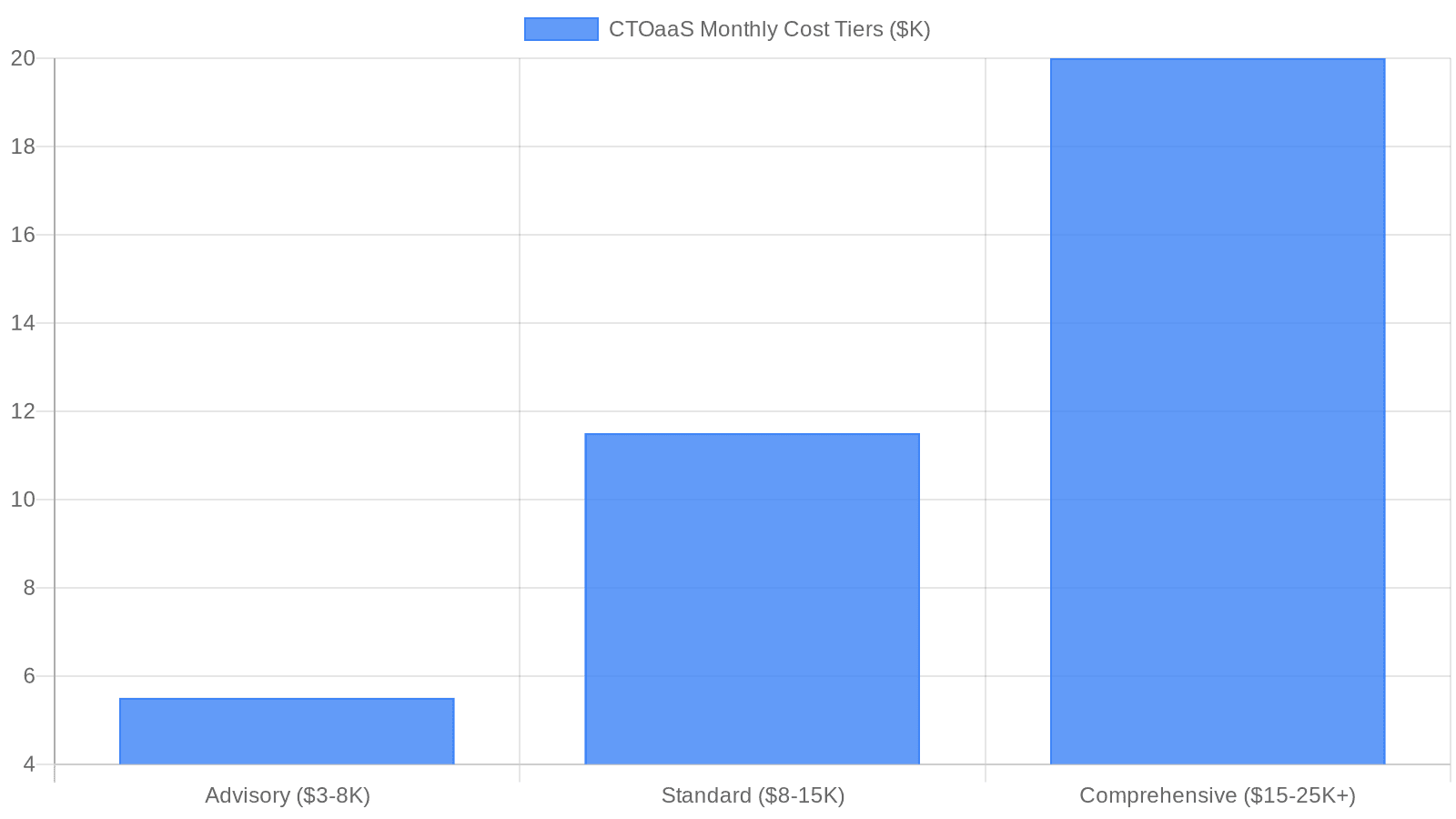
CTOaaS pricing varies widely depending on the provider's experience, the scope of the engagement, and the market. Here are the typical ranges:
Advisory Tier
- $3,000 - $8,000 per month
- Typically includes 10-20 hours per month
- Strategy, architecture review, team guidance, stakeholder communication
- Best for companies that have a development team but need senior oversight
Standard Tier
- $8,000 - $15,000 per month
- Typically includes 20-40 hours per month
- Everything in advisory, plus deeper hands-on involvement -- hiring support, vendor management, process improvement, sprint planning participation
- Best for companies going through significant technical change
Comprehensive Tier
- $15,000 - $25,000+ per month
- Near full-time involvement (30-40+ hours per month)
- Deep embedding in the leadership team, hands-on technical work, team management
- Best for companies that functionally need a full-time CTO but want the flexibility of a service engagement
For context, a full-time CTO in a major market typically costs $250,000-$400,000+ per year in salary and benefits alone, before equity. Even the comprehensive CTOaaS tier represents a significant cost saving, with the added benefit of no long-term employment commitment. For a detailed cost comparison between the fractional and full-time models, see our guide on fractional vs full-time CTO.
Pros and Cons
Advantages
- Speed to value -- you can have senior technical leadership in place within weeks, not months
- Cost efficiency -- access CTO-level experience at a fraction of the full-time cost
- Flexibility -- scale the engagement up or down as your needs change, without the complexity of hiring or firing an executive
- Breadth of experience -- CTOaaS providers typically work across multiple companies and industries, giving them pattern recognition that a single-company CTO may lack
- Reduced risk -- if the relationship is not working, you can change providers without the pain and cost of an executive termination
- Defined deliverables -- productised models make it clearer what you are paying for and what you should expect
Disadvantages
- Divided attention -- your CTOaaS provider is working with other clients. They are not thinking about your problems at 2am (though neither is a salaried CTO, ideally)
- Cultural distance -- an external provider will never be as embedded in your company culture as a full-time team member
- Execution limits -- at advisory tiers, you still need someone internal to execute. The CTOaaS provider sets direction but does not build the product
- Dependency risk -- if your provider leaves or their firm changes direction, you need to find a replacement
- Not a co-founder -- a CTOaaS provider does not have equity-level skin in the game. Their incentives are aligned through the professional relationship, not through ownership
How to Choose a CTOaaS Provider
The market has grown quickly, and quality varies. Here is what to evaluate:
Relevant Experience
Look for providers who have worked with companies at your stage and in your domain. A CTOaaS provider who has only worked with enterprise companies may not be the right fit for a seed-stage startup, and vice versa. Ask for case studies or references from similar companies.
Clarity of Offering
The best providers are clear about what is included, what costs extra, and what is out of scope. Be cautious of providers who cannot articulate their process or whose proposals are vague about deliverables.
Communication Style
You will be working closely with this person or team. Do they communicate in a way that makes sense to you? Can they explain technical concepts without jargon when needed? Do they listen more than they talk in initial conversations?
Team vs. Individual
Some CTOaaS providers are solo practitioners. Others have a team behind them. Neither is inherently better, but understand which model you are getting. A solo provider offers deeper personal attention. A team-backed provider may offer more capacity and a broader skill set.
Onboarding Process
A strong provider will have a structured onboarding process -- not just a kickoff call. They should be asking hard questions about your business, your goals, your team, and your technology before they start making recommendations.
Exit Strategy
Ask how the engagement ends. A good CTOaaS provider should be building your internal capability, not creating dependency. They should be willing to discuss what success looks like and when you might be ready to transition to a full-time CTO.
For a broader look at the fractional CTO services landscape, including how to evaluate different engagement models, see our detailed breakdown.
When to Graduate to a Full-Time CTO
CTOaaS is not meant to be permanent. For most companies, it is a bridge -- a way to access senior technical leadership while you grow into the stage where a full-time hire makes sense.
Here are the signals that it might be time to transition:
- Engineering team size exceeds 15-20 people -- at this point, the technology organisation needs dedicated full-time leadership for culture, hiring, and day-to-day management
- Technology is your primary competitive advantage -- if your product differentiation is deeply technical, you need a CTO who lives and breathes your specific domain every day
- You are entering a regulated market -- compliance-heavy industries (fintech, healthtech, defence) often require a named CTO for regulatory and partnership purposes
- The complexity demands full-time attention -- multiple product lines, complex integrations, or a platform business model may require more than what a service engagement can provide
- You have found the right person -- sometimes the CTOaaS provider themselves becomes the right candidate for the full-time role. This is a feature, not a bug
The best CTOaaS providers will actively help you with this transition. They will help define the role, screen candidates, and ensure a smooth handover. If your provider resists the conversation about transitioning to a full-time CTO, that is a red flag.
Making the Decision
If you are reading this guide, you are likely at a point where the status quo is not working. Maybe you are a founder making technology decisions outside your expertise. Maybe your team is growing faster than your ability to manage the technical complexity. Maybe you are preparing for a funding round and need a credible technology narrative.
CTO as a Service is a practical, lower-risk way to solve these problems. It gives you access to the strategic thinking and experienced guidance that a strong CTO provides, at a price point and commitment level that matches where your company is today.
The key is to be honest about what you need. If you need a technology co-founder who will be in the trenches with you every day, CTOaaS is not the answer. If you need senior technical judgment, strategic direction, and experienced oversight -- and you need it faster and more affordably than a full-time hire -- it is worth serious consideration.
Companies like FractionalChiefs maintain networks of vetted fractional and CTOaaS providers across industries, which can be a useful starting point if you are evaluating your options.
Whatever path you choose, the worst option is no technical leadership at all. The decisions you make -- or avoid making -- about your technology today will compound for years. Getting experienced guidance early, in whatever form works for your company, is almost always worth the investment.
Ready to level up?
Discover your strengths and gaps with our free CTO Readiness Assessment.
Take the CTO Readiness Assessment