CTO Skills: The Complete Framework for Technical Leaders
The CTO role demands a broader skill set than almost any other position in technology. You need enough technical depth to earn credibility, enough leadership ability to build and retain teams, enough business sense to sit at the executive table, and enough self-awareness to keep growing when the feedback gets sparse.
Yet most CTOs — and most aspiring CTOs — have never seen a structured framework for what "CTO skills" actually means. They know they need to be "technical" and "strategic," but the specifics remain vague. That vagueness is a problem, because you cannot develop skills you have not defined.
This article presents a complete framework for CTO skills, organised into five dimensions. Whether you are preparing for a CTO role, already in one, or coaching someone who is, this framework gives you a practical map for assessment and development.

Why a Framework Matters
Most technical leaders develop their skills reactively. A team conflict forces them to learn about difficult conversations. A failed migration teaches them about risk management. A board meeting gone wrong reveals their communication gaps.
Reactive development works, but it is slow and painful. A structured framework lets you identify gaps before they become crises, build development plans that are deliberate rather than accidental, and measure progress over time.
The five dimensions below are drawn from what separates effective CTOs from struggling ones across startups, scale-ups, and enterprises.
The 5 CTO Skill Dimensions
Every CTO operates across five interconnected areas. Weakness in any single dimension will eventually limit your effectiveness, no matter how strong you are in the others.
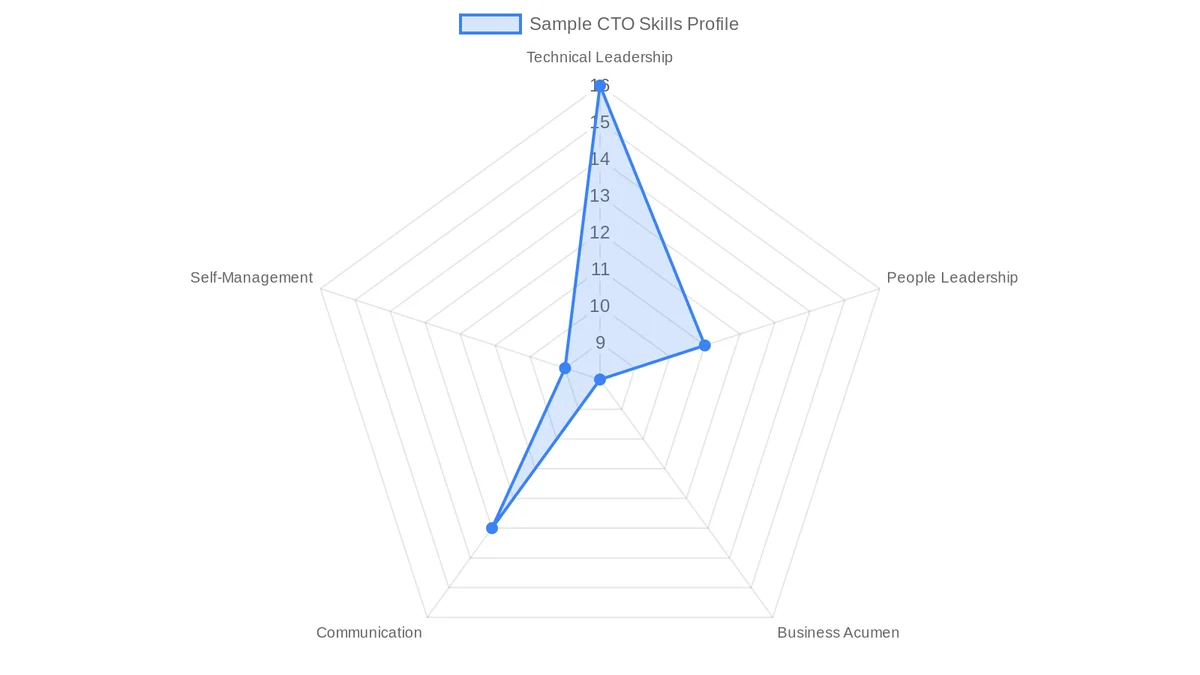
1. Technical Leadership
Technical Leadership is the foundation — the reason a CTO exists in the first place. But at the CTO level, this is not about writing the best code. It is about making the right technical decisions at the right time and ensuring your organisation can execute on them.
What this includes:
- Architecture and systems thinking. Can you evaluate trade-offs across complex systems? Do you understand how decisions made today will constrain or enable options three years from now?
- Technology strategy. Can you align technology choices with business objectives? Do you know when to build, buy, or partner?
- Technical risk management. Can you identify the technical risks that could derail the business — security vulnerabilities, scalability bottlenecks, single points of failure — and address them before they become emergencies?
- Engineering excellence. Can you set and maintain standards for code quality, testing, deployment, and incident response without micromanaging?
- Innovation and evaluation. Can you separate genuinely useful new technologies from hype? Do you have a process for evaluating and adopting new tools and approaches?
Practical example: A CTO at a Series B fintech company noticed that their monolithic architecture was becoming a bottleneck as they added new product lines. Rather than launching a company-wide microservices rewrite — the classic mistake — they identified the three services with the clearest bounded contexts, migrated those first, and used the experience to build internal expertise before tackling the harder decomposition. The technical decision was good. The sequencing and risk management made it excellent.
Common gap: Many CTOs who rose through the IC track have deep technical skills but struggle with technology strategy — connecting technical decisions to business outcomes. Conversely, CTOs who came up through management sometimes lack the architecture depth to challenge their teams' technical proposals effectively.
2. People Leadership
Technology is built by people, and the CTO's ability to attract, develop, and retain strong engineers is often the single biggest determinant of long-term success. People Leadership goes far beyond basic management.
What this includes:
- Hiring and talent strategy. Can you define what great looks like for your organisation, build a pipeline, and close top candidates? Do you know when to hire senior versus junior, when to use contractors, and when to invest in growing people internally?
- Team structure and design. Can you organise teams for autonomy, speed, and alignment? Do you understand the trade-offs between functional teams, cross-functional squads, and platform teams?
- Coaching and development. Can you develop your engineering managers into strong leaders? Can you give feedback that changes behaviour without damaging relationships?
- Culture building. Can you create an engineering culture that attracts the kind of people you want while filtering out those who would undermine it?
- Conflict resolution. Can you navigate disagreements between strong-willed technical leaders, between engineering and product, or between your team and the rest of the business?
Practical example: An engineering organisation was losing senior engineers at an alarming rate. The CTO's instinct was to throw money at the problem — market adjustments, retention bonuses. Instead, they ran structured stay interviews and discovered that the real issue was a lack of meaningful technical challenges. Senior engineers felt stuck maintaining legacy systems while all the interesting new work went to a small "innovation team." Restructuring to distribute challenging work across all teams reduced attrition more effectively than compensation changes would have.
Common gap: First-time CTOs frequently underinvest in developing their engineering managers. They default to managing everyone directly, which does not scale, or they hire experienced managers and assume they do not need coaching, which leads to inconsistent leadership across the organisation.
3. Business Acumen
The CTO who cannot speak the language of business will always be seen as a cost center rather than a strategic asset. Business Acumen is what transforms a senior technologist into a true executive.
What this includes:
- Financial literacy. Can you build and manage an engineering budget? Do you understand how technology investment decisions affect gross margin, burn rate, and unit economics?
- Product thinking. Can you contribute meaningfully to product strategy, not just execute on it? Do you understand your customers well enough to propose technology-enabled solutions the product team has not considered?
- Market awareness. Do you understand the competitive landscape well enough to make technology decisions that create defensible advantages?
- Strategic planning. Can you develop a multi-year technology roadmap that supports the company's business strategy? Can you communicate that roadmap to non-technical stakeholders in terms they care about?
- Vendor and partnership management. Can you evaluate build-versus-buy decisions objectively? Can you negotiate with vendors and manage strategic technology partnerships?
Practical example: A CTO at a marketplace company noticed that their customer acquisition cost was climbing while competitors with inferior technology were growing faster. Rather than proposing more engineering headcount to build features, they analysed the unit economics and realised the real leverage was in reducing infrastructure costs per transaction — which would allow the company to undercut competitors on take rate while maintaining margins. A business insight, enabled by technical understanding, that changed the company's competitive position.
Common gap: Many CTOs avoid financial conversations because they find them uncomfortable or believe "that is the CFO's job." But a CTO who cannot articulate the ROI of a platform rewrite in financial terms will lose every budget negotiation. If you find yourself needing to bridge the gap between technical leadership and business strategy, working with a fractional CTO or executive coach can accelerate that development significantly.
4. Communication
Communication is the multiplier that makes every other skill more effective. A CTO with brilliant ideas and poor communication will consistently lose to one with good ideas and excellent communication.
What this includes:
- Executive communication. Can you present to the board, the CEO, and non-technical executives in a way that is clear, concise, and persuasive? Can you translate technical complexity into business impact?
- Written communication. Can you write technical strategy documents, architecture decision records, and company-wide announcements that are clear and compelling?
- Stakeholder management. Can you manage expectations across product, sales, marketing, and customer success when timelines slip or priorities shift?
- Public speaking and external presence. Can you represent the company at conferences, in press interviews, and with partners? Can you use your external presence to attract talent?
- Listening and synthesis. Can you listen to competing perspectives from across the organisation, synthesise them, and articulate a path forward that people can rally behind?
Practical example: An enterprise CTO needed board approval for a significant investment in data infrastructure. Their first draft of the board presentation was twelve slides of architecture diagrams and technology benchmarks. After coaching, they restructured it into three slides: the business problem (declining customer retention), the proposed solution (personalisation engine powered by unified data platform), and the expected impact (projected retention improvement worth a specific revenue figure). The board approved it in ten minutes.
Common gap: Technical leaders tend to over-explain. They provide all the context and reasoning before getting to the point, which loses executive audiences. The inverse is also common: CTOs who can communicate up to the board but struggle to communicate down to individual engineers in a way that creates genuine alignment rather than just compliance.
5. Self-Management
Self-Management is the dimension most CTOs ignore — and the one that most often derails otherwise successful leaders. The CTO role is uniquely isolating, and without deliberate self-management, burnout, poor decision-making, and career stagnation are predictable outcomes.
What this includes:
- Self-awareness. Do you know your strengths, blind spots, and triggers? Can you recognise when stress is affecting your judgement?
- Time and energy management. Can you protect your time for strategic work when the organisation constantly pulls you into operational firefighting?
- Continuous learning. Do you have a deliberate practice for staying current with technology trends, leadership approaches, and industry developments?
- Resilience and stress management. Can you maintain composure and clear thinking during crises — a production outage, a key-person departure, a funding round falling through?
- Seeking feedback. Do you have mechanisms for getting honest feedback when you are the most senior technical person in the room? Do you act on that feedback?
Practical example: A CTO at a fast-growing startup realised they were spending nearly every hour in meetings, leaving zero time for the strategic thinking their role demanded. They implemented a simple system: three "no-meeting" mornings per week, a weekly one-hour strategy block with their Chief of Staff, and a quarterly offsite day for long-range planning. Within two months, they had produced their first real technology strategy document — something they had been meaning to write for over a year.
Common gap: CTOs who were promoted for their technical brilliance often struggle most with self-awareness. They default to solving every problem personally rather than delegating, they avoid asking for help because they have always been the one providing answers, and they burn out because they have never had to manage their energy at this intensity level before.
How to Assess Your CTO Skills
Reading about these dimensions is useful. Knowing where you actually stand across them is transformational.
The most effective way to assess your skills is with a structured evaluation that scores you across all five dimensions and identifies your specific strengths and gaps. We built the CTO Skills Assessment for exactly this purpose — it takes about ten minutes and gives you a detailed breakdown of where you stand in each dimension.
Beyond formal assessment, here are three practical approaches:
360 feedback with structured questions. Ask your direct reports, peers, and CEO to rate you on specific behaviours within each dimension. Generic "how am I doing" conversations produce generic answers. Specific questions like "how effectively do I translate technical decisions into business impact for the leadership team" produce actionable feedback. Our CTO readiness checklist provides 25 specific questions mapped to these five dimensions that you can use as a starting point for self-assessment.
Incident reviews on yourself. After significant events — a difficult board meeting, a team conflict, a project that went off the rails — do a personal retrospective. Which dimension was the bottleneck? What would a stronger version of that skill have looked like in practice?
Peer benchmarking. Find two or three CTOs at similar-stage companies and have candid conversations about challenges. You will quickly discover which of your struggles are universal (everyone finds board communication hard at first) and which are personal gaps that need targeted development.
Building a Development Plan

Once you know your gaps, resist the temptation to work on everything at once. Effective skill development follows a few principles:
Focus on one dimension per quarter. Pick the dimension that is most limiting your effectiveness right now. A CTO with strong technical skills but weak communication is not going to solve their communication gap in a week — but they can make meaningful progress with three months of focused effort.
Combine learning with doing. Reading a book on executive communication is a start. Volunteering to present the next board update is where the learning actually happens. Every development goal should have a real-world practice opportunity attached to it.
Get a feedback partner. Find someone — a coach, a peer, a trusted direct report — who will give you honest, specific feedback on the skill you are developing. Without external feedback, you will overestimate your progress.
Track leading indicators, not just outcomes. If you are working on People Leadership, do not just wait to see if attrition drops. Track whether you are having regular one-on-ones with your managers, whether you are giving specific feedback weekly, and whether your managers report feeling more supported.
Common Skill Gaps by Career Stage

Different career stages produce predictable skill gaps. Understanding yours can save you years of floundering.
First-time CTOs (just promoted or hired into first CTO role):
- Tend to over-index on Technical Leadership because it is comfortable
- Usually weakest in Business Acumen and Communication (especially board-level)
- Often neglect Self-Management because the excitement of the new role masks early burnout signals
Experienced CTOs at growing companies (2-5 years in role):
- Technical Leadership is usually strong, though it may have shifted from hands-on to strategic without them noticing the gap
- People Leadership gaps emerge as the organisation scales past the point where they can manage directly
- Communication challenges increase as the number of stakeholders multiplies
Enterprise CTOs (large organisations, 5+ years in role):
- Risk becoming detached from technical reality — their Technical Leadership becomes theoretical rather than practical
- Self-Management becomes critical as political complexity and meeting load increase
- Business Acumen may be strong but can calcify into "how we have always done things" rather than adapting to new market conditions
Understanding what a CTO actually does at different company stages helps you anticipate which skills will matter most in your next phase. Similarly, knowing the complete career roadmap to the CTO role helps earlier-stage leaders build the right skills proactively rather than reactively.
Conclusion
The CTO role demands excellence across five distinct skill dimensions: Technical Leadership, People Leadership, Business Acumen, Communication, and Self-Management. No one starts strong in all five. The CTOs who thrive are not the ones who arrive fully formed — they are the ones who honestly assess their gaps and systematically close them.
Start by understanding where you are. Take the CTO Skills Assessment to get a baseline across all five dimensions. Then pick the one dimension that is most limiting your impact right now and spend the next quarter deliberately developing it.
The skills that got you to this point in your career are not the same skills that will make you successful as a CTO. Knowing which skills to build next is the first step toward building them.
Ready to level up?
Discover your strengths and gaps with our free CTO Readiness Assessment.
Take the CTO Readiness Assessment