How to Become a CTO: The Complete Career Roadmap
If you have ever wondered how to become a CTO, you are not alone. The Chief Technology Officer role sits at the intersection of engineering excellence, business strategy, and people leadership. It is one of the most coveted positions in tech, and one of the least understood.
This guide lays out the complete career roadmap, from your first engineering role to the executive table. Whether you are a senior engineer eyeing the C-suite or a VP of Engineering wondering what comes next, this is the practical playbook you need.

What Is a CTO?
The CTO is the most senior technology leader in a company. But the role varies dramatically depending on company size and stage:
- Startup CTO (Seed to Series A): You are the technical co-founder. You write code, pick the stack, hire the first engineers, and make architecture decisions that will either scale or haunt you for years.
- Growth-stage CTO (Series B to D): You shift from building to leading builders. Your job is hiring, setting technical direction, and making sure engineering velocity keeps pace with business growth.
- Enterprise CTO (Public company / 500+ engineers): You are a strategic executive. You set the technology vision, manage a multi-layered org, work with the board, and ensure technology is a competitive advantage rather than a cost center.
The common thread across all stages: the CTO is responsible for making sure the right technology decisions are made at the right time.
The CTO Career Path: Five Stages
There is no single path to the CTO role, but most successful CTOs pass through these stages:

Stage 1: Individual Contributor (Years 0-5)
This is where you build your technical foundation. You write code, ship features, debug production issues, and develop an intuition for what good engineering looks like.
What matters here:
- Depth in at least one technology domain (backend, infrastructure, data, mobile)
- Exposure to the full development lifecycle, from design through deployment and maintenance
- Building a reputation as someone who delivers reliably
Common mistake: Staying in IC mode too long without developing leadership instincts. Technical depth matters, but if you never mentor a junior engineer or lead a project, you are building only half the skillset.
Stage 2: Tech Lead / Engineering Manager (Years 4-8)
This is the first real fork in the road. You start leading a team, whether as a hands-on tech lead or a people-focused engineering manager.
What matters here:
- Learning to multiply your impact through others instead of just your own output
- Developing the ability to make technical decisions that balance speed, quality, and maintainability
- Understanding how your team's work connects to business outcomes
Common mistake: Trying to remain the best coder on your team. Your job has changed. The measure of your success is now your team's output, not your personal commit history. For a detailed breakdown of what this transition looks like in practice, see our guide on the engineering manager to CTO path.
Stage 3: Senior Engineering Leader (Years 7-12)
At this level you are typically a Director of Engineering or Senior Staff Engineer. You own a significant chunk of the technical landscape and manage multiple teams or a critical platform.
What matters here:
- Cross-functional collaboration with product, design, and business stakeholders
- Ability to translate business strategy into technical roadmaps
- Hiring and developing strong engineering managers
- Managing technical debt strategically, not just accumulating it or pretending it does not exist
Common mistake: Getting stuck in the "comfortable director" zone. Many talented leaders plateau here because they enjoy the work and stop pushing into unfamiliar territory like P&L ownership, board interactions, or company-wide strategy.
Stage 4: VP of Engineering (Years 10-15)
The VP of Engineering role is the final stepping stone. You run the engineering organisation and report to the CTO or CEO.
What matters here:
- Owning engineering budget, headcount planning, and resource allocation
- Building a leadership bench: your directors and senior managers should be strong enough that you can step away for a week without anything catching fire
- Developing a point of view on where technology in your industry is heading
- Learning to communicate with the board and investors
Common mistake: Defining yourself purely as "the engineering leader." To make the jump to CTO, you need to be seen as a business leader who happens to have deep technical expertise. The VP of Engineering to CTO transition is one of the most underestimated career moves in technology -- it requires a fundamental shift in identity.
Stage 5: CTO
You have arrived. But the learning curve is steeper than ever. The CTO role demands a blend of skills that no previous role fully prepares you for.
What matters here:
- Setting the technology vision and communicating it clearly across the company
- Being a strategic partner to the CEO and board
- Making high-stakes decisions with incomplete information
- Representing the company externally: at conferences, with partners, and in the press
- Attracting and retaining world-class talent
Essential Skills for a CTO
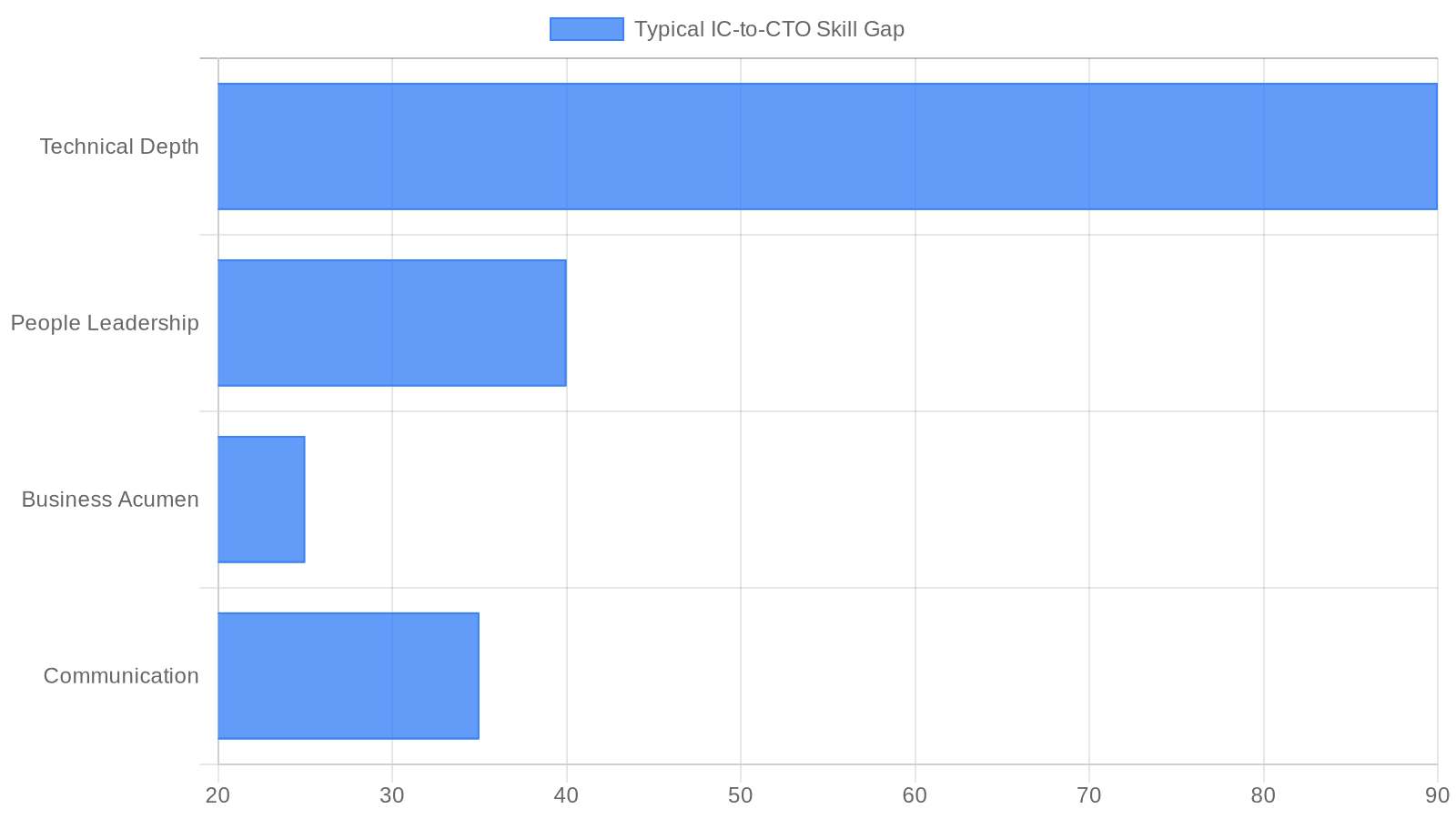
Technical Leadership
You do not need to be the best coder in the room, but you need enough technical depth to earn credibility, ask the right questions, and detect when your team is heading down the wrong path.
Key capabilities:
- Architecture judgment: You can evaluate trade-offs between different technical approaches and make decisions that balance short-term speed with long-term scalability.
- Technology radar: You stay current on industry trends without chasing every shiny new framework. You know when to adopt and when to wait.
- Technical debt management: You can quantify the cost of tech debt in terms the business understands and build a case for investment.
For a complete breakdown of all five skill dimensions, see our CTO skills framework.
People Management and Organisational Design
As CTO, your "product" is the engineering organisation itself. How you structure teams, define roles, set culture, and develop leaders will determine your success more than any technical decision.
Key capabilities:
- Building and coaching a strong leadership team
- Designing org structures that minimise coordination overhead
- Creating a culture of ownership, psychological safety, and continuous improvement
- Managing performance effectively, including difficult conversations
Business Acumen
This is where many aspiring CTOs fall short. You need to understand how the business makes money, what drives customer value, and how technology investments translate into competitive advantage.
Key capabilities:
- Reading and interpreting financial statements (P&L, balance sheet, cash flow)
- Building business cases for technology investments with clear ROI
- Understanding your company's market position, competitors, and growth levers
- Contributing to company strategy beyond just the technology domain
Communication
A CTO who cannot communicate effectively is just an expensive engineer. You need to tailor your message to every audience: engineers, product managers, executives, board members, customers, and candidates.
Key capabilities:
- Executive communication: Concise, decision-oriented, focused on outcomes rather than implementation details
- Technical communication: Clear enough that engineers trust your judgment and understand the reasoning behind decisions
- External communication: Comfortable speaking at conferences, representing the company to partners, and telling the technology story to candidates
Education and Certifications
Here is the honest truth: no specific degree or certification is required to become a CTO. The role is earned through demonstrated leadership and impact, not credentials.
That said, a strong educational foundation helps:
- Computer Science or Engineering degree: Still the most common background for CTOs, though not strictly required. It gives you the fundamentals that make advanced technical discussions possible.
- MBA or business education: Increasingly valuable as you move into senior leadership. It fills gaps in financial literacy, strategy, and organisational behaviour. Some CTOs pursue an MBA mid-career; others pick up the knowledge through experience and targeted reading.
- Executive education: Short programs from institutions like MIT, Stanford, or INSEAD can accelerate your development in specific areas like leadership, strategy, or innovation management.
What matters far more than any credential is a track record of building things that matter and leading teams that deliver.
Building Your Track Record
Your path to CTO is built on a portfolio of increasingly significant bets that paid off. Here is how to build that track record deliberately:
Take on the hard problems
Volunteer for the projects that others avoid: the legacy system migration, the performance crisis, the team that has lost its best people. These situations, while uncomfortable, are where you develop the judgment and resilience that define great CTOs.
Own outcomes, not just outputs
Stop measuring your success by lines of code, features shipped, or projects completed. Start measuring it by business impact: revenue enabled, costs reduced, customer satisfaction improved, time-to-market shortened.
Build relationships across the business
The CTO role is inherently cross-functional. Start building relationships with sales, marketing, finance, and operations leaders now. Understand their challenges. Learn their language. The CTO who only talks to engineers will never be effective at the executive level.
Develop a public presence
Write about what you are learning. Speak at meetups and conferences. Contribute to open source. This builds your personal brand and demonstrates thought leadership, both of which matter when you are being considered for CTO roles.
Find a mentor or executive coach
Many successful CTOs credit a mentor or coach with accelerating their development. Find someone who has been in the role and can give you honest feedback about your blind spots. If you are serious about preparing for the CTO role, consider working with a CTO coach who can help you identify specific gaps and build a development plan.
Common Mistakes on the Path to CTO
Waiting to be promoted instead of acting like a CTO. The best way to become a CTO is to start thinking and operating like one before you have the title. Take initiative on strategic questions, build cross-functional relationships, and demonstrate business acumen.
Neglecting the business side. Technical excellence alone will not get you to the C-suite. If you cannot connect technology decisions to business outcomes, you will always be seen as a technical specialist rather than a business leader.
Trying to do it alone. The CTO role is too big for any one person. If you have not learned to build strong teams, delegate effectively, and trust your leaders, you will burn out or bottleneck the organisation.
Ignoring soft skills. Communication, empathy, political awareness, and executive presence are not optional extras. They are core competencies. The CTO who dismisses "soft skills" is usually the one who plateaus at VP.
Optimising for the wrong company. Not every company values or needs a CTO. Some orgs have the title but not the role; others have the role but give it a different name. Be intentional about where you work and make sure the opportunity matches your growth goals.
Are You Ready?
Becoming a CTO is not about checking boxes. It is about developing the judgment, skills, and leadership presence to guide a company's technology strategy at the highest level.
If you are on this path and want to know where you stand, take the CTO Readiness Assessment. It is free, takes about ten minutes, and gives you a personalised view of your strengths and development areas across the key CTO competencies.
Already in a CTO or fractional CTO role and looking for your next engagement? FractionalChiefs connects experienced technology executives with companies that need senior leadership without a full-time hire.
Ready to level up?
Discover your strengths and gaps with our free CTO Readiness Assessment.
Take the CTO Readiness Assessment